Light rain fell over the yard of an old orphanage. The walls were peeling, the iron gate rusted—but inside, the laughter of children still echoed, small yet sincere.
A black luxury car stopped at the gate.
The door opened.
A middle-aged man stepped out, dressed in a neat suit. Beside him, a ten-year-old boy followed—clean, well-dressed, and slightly bored.
“Dad, why are we here?” he asked with little interest.
“To deliver donations,” the father replied briefly.
They walked inside.
The orphanage children lined up, welcoming them with warm smiles. Some waved shyly, others simply bowed their heads. The place was simple, but filled with warmth.
But not everyone joined.
In the corner, one boy sat alone on the floor.
He was thin. Dirty. His clothes were worn and oversized. In his hands, he held a small broken toy car—one of its wheels missing.
The rich boy noticed him.
Then walked closer.
“That’s broken,” he said casually. “Why do you still keep it?”
The boy looked at him for a moment.
His eyes were calm… but deep.
“It’s the only thing I have from… my parents.”
The answer made the rich boy fall silent.
For the first time, he had nothing to say.
But before the moment could grow, a caretaker approached in a hurry.
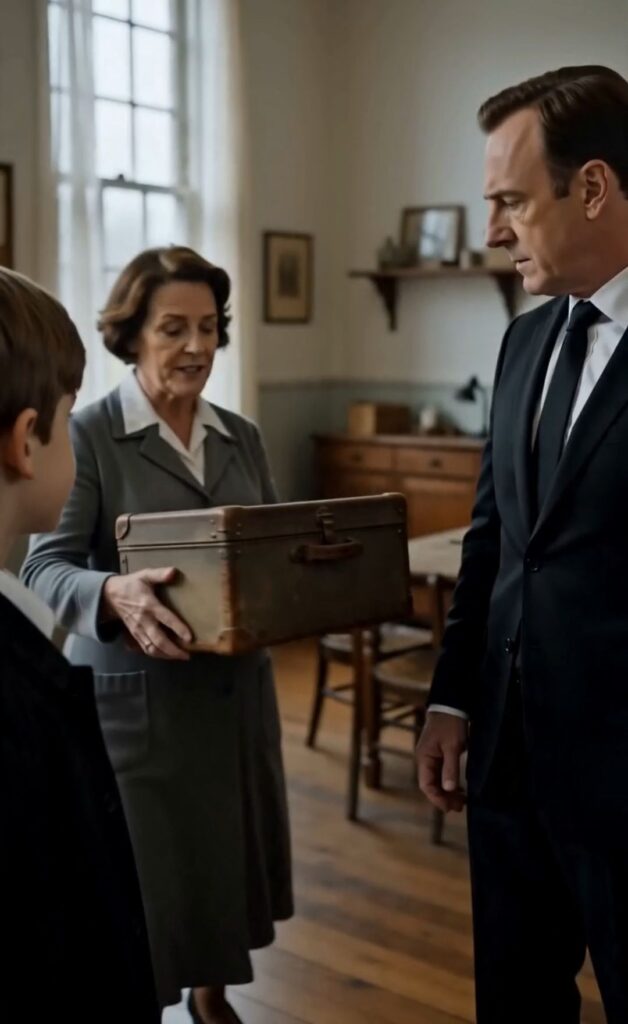
She carried a small dusty box.
“Sir… we found this in the old storage,” she said carefully. “It may belong to a child who went missing years ago.”
The father didn’t seem very interested.
“Just open it,” he said.
The box was opened slowly.
Inside—a small baby blanket… and a necklace.
The necklace shimmered softly.
Far too valuable for a place like this.
The father froze.
His eyes widened.
His hands trembled as he picked it up.
Memories crashed into him—hospital walls, a crying baby, sudden loss… and the necklace he had once placed around his missing child’s neck.
His breath caught.
His gaze slowly shifted…
toward the boy in the corner.
His heart pounded.
He walked closer.
Slowly.
As if each step carried a truth he had long feared.
“How long have you been here?” he asked, his voice heavy.
“Since I was little,” the boy answered softly.
“What’s your name?”
The boy hesitated.
“…I don’t know my real name. They call me Raka.”
The man’s world shattered in silence.
He knelt down.
His hands trembled as he touched the boy’s shoulder.
“This necklace… have you ever seen it?”
The boy nodded.
“I used to have it… but it got lost.”
Tears fell without permission.
“…my son…”
The boy went still.
Confused.
Not understanding.
Behind them, the rich boy stood frozen.
“Who… is he?” he asked quietly.
The father turned.
His voice heavy:
“He… is your brother.”
Part 2
The ride home felt different.
No complaints.
No boredom.
Only silence filled with questions.
Raka sat in the back seat, holding his broken toy car. He stared out the window, as if afraid this would all disappear.
The boy who had lived in comfort now sat quietly.
His thoughts heavy.
“Why… him?” he finally asked.
The father took a deep breath.
“Because he was never truly lost… we just hadn’t found him yet.”
The car stopped in front of a large house.
The gate opened.
Lights turned on.
Everything looked grand.
But to Raka—it all felt unfamiliar.
Too big.
Too quiet.
“Come,” the father said gently.
For the first time, he held the boy’s hand.
Carefully.
They walked inside.
A woman stood in the living room.
She smiled… then froze.
Her eyes locked onto Raka.
“Who is he?” her voice trembled.
The father looked at her.
“Our son.”
Her world collapsed.
Tears fell instantly.
She stepped closer.
Her hands trembled as she touched his face.
“…my son…”
Raka didn’t move.
He only stared.
Confused.
Distant.
In the corner, the boy who had always lived comfortably stood frozen.
He watched everything—
the hugs,
the tears,
the love… he now had to share.
For the first time—
he felt afraid.
“If he’s your son… then who am I?”
Silence filled the room again.
The father turned slowly.
“You… are still our son.”
But the answer didn’t bring peace.
Ending
The days that followed were not easy.
Raka was afraid to sit on the sofa.
He ate slowly.
He still hid leftover food… just in case.
Meanwhile, his brother began to change.
No more arrogance.
No more mockery.
He started to observe.
To understand.
One night, he saw Raka secretly hiding food in a small bag.
His hands moved quickly—
as if afraid it would be taken.
His chest tightened.
He stepped closer.
“…you don’t have to save that,” he said softly.
Raka flinched.
Looked at him.
Unsure.
For the first time—
there was no cruelty.
Only honesty.
A few seconds passed.
Silence.
Then he sat beside him.
Awkward.
“…I’m sorry,” he said quietly.
Raka didn’t answer.
Didn’t smile.
But he didn’t lower his head anymore.
And that was enough.
Time passed.
Not everything healed at once.
But slowly—
they ate together.
Learned together.
And began to laugh together.
One evening, they sat in the yard.
The sky turned into sunset again.
Raka looked up.
“This… is real, right?” he asked softly.
His brother gave a small smile.
“Yeah.”
He paused.
Then added:
“…you’re not alone anymore.”
For the first time—
Raka smiled.
Not because of the house.
Not because of the food.
But because—
he finally had a place to belong.
And that’s where everything truly began.
Not from wealth.
Not from loss.
But from two boys—
who learned to become brothers.
And a family—
that finally found its way back home.
Tinggalkan Balasan